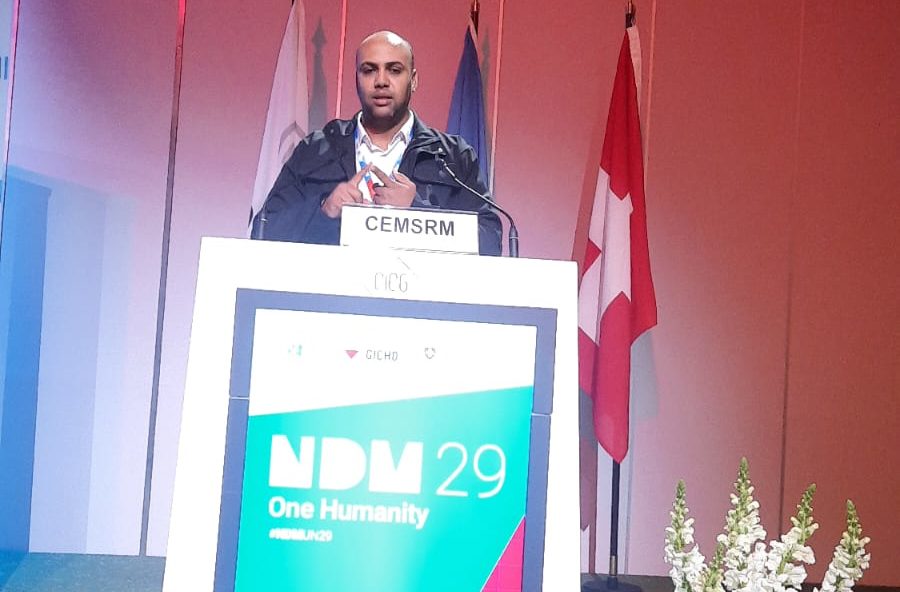
 Geneva, April 23, 2026 – In the quiet corridors of the international conference center where experts gather every year to discuss global demining efforts, one voice stood out this week for its deeply human tone. Thami El Aissaoui, president of the Euro-Mediterranean Center for Mine Risk Monitoring (CEMSRM), did not come to Geneva merely to talk about technical protocols or clearance statistics. He came to speak about real people — men, women, and especially children — whose daily lives are still shadowed by the threat of hidden explosives planted decades ago.
Over three days, from April 22 to 24, during the 29th International Meeting of National Mine Action Programme Directors and UN Advisors, Mr. El Aissaoui held numerous bilateral meetings with government officials and international experts. His message was clear and urgent: anti-personnel mines laid by Polisario militias continue to claim victims in Morocco’s southern provinces, robbing families of their loved ones, shattering childhoods, and holding back entire communities from building a peaceful future.
“Behind every mine on a map, there is a human story,” he said during the meetings. “A shepherd who never returns home with his flock, a mother watching her child lose a limb, a young person forced to abandon dreams because the land they love has become a place of constant danger.”
Morocco has not stood idle. The Kingdom has developed a comprehensive approach that goes far beyond simply removing explosives from the ground. It includes widespread risk education in villages, specialized medical care for the wounded, long and difficult physical rehabilitation, and dedicated programs to help victims regain their place in society through professional reintegration — a patient, daily effort to restore dignity where conflict has left deep scars.
Yet Mr. El Aissaoui stressed that technical demining alone will never fully heal this wound. A lasting solution must be political and, above all, human. That is why he strongly advocated for a humanitarian reading of Morocco’s Autonomy Initiative, presenting supporting documents to the delegations.
“The Autonomy Initiative is not just a diplomatic proposal,” he explained. “It offers a real chance for return, for peace, and for restored dignity to thousands of families still living in the Tindouf camps, far from their homeland.”
He recalled King Mohammed VI’s warm appeal in his October 31, 2025 speech, in which the monarch invited these families to come back and build a shared future together in a united and prosperous Morocco.
Throughout the UN meeting, the CEMSRM will continue to carry this message: the priority must be to free people not only from the physical danger of mines, but also from the long-standing fear and uncertainty that have overshadowed their lives.
In a world where conflicts too often drag on, this discreet yet powerful appeal from Geneva serves as a reminder of a simple truth too easily forgotten: behind every mine lies a human life that deserves to walk freely on its land once again
